Ancient Buddhist stories reveal a simple truth: our actions shape who we're becoming, one choice at a time.
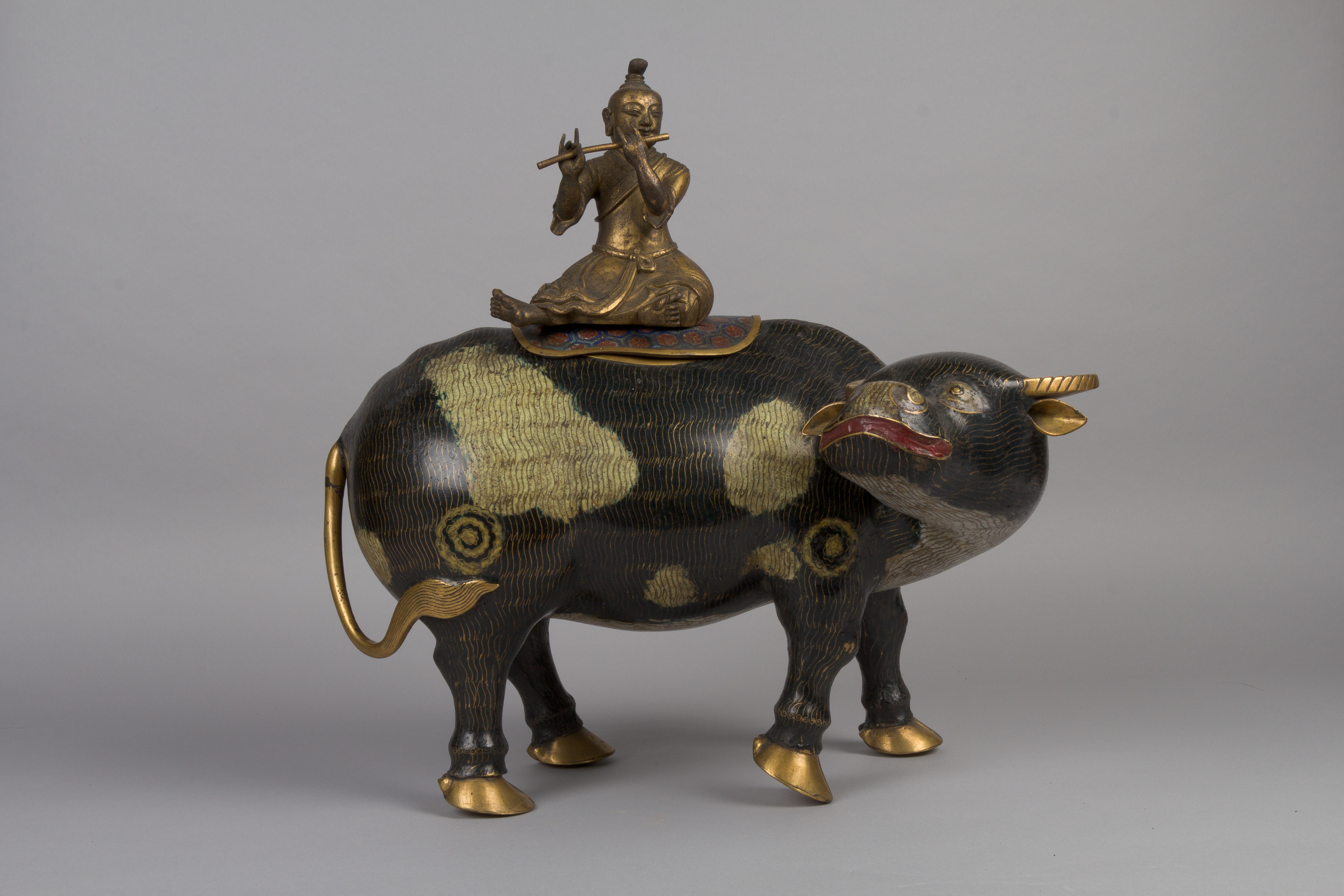
Herdboy with water buffalo, China, 18th–19th century. Cloisonné enamel, gilt copper alloy. The Metropolitan Museum of Art, Gift of Edward G. Kennedy, 1930 (30.128.2a–c).
When we hear that our actions have consequences, we often think back to childhood, and perhaps a particular scolding from our parents comes to mind. Two memories from my childhood stand out, each teaching me something different about how we learn. When I was six or seven, a friend convinced me that dirt tasted good. One handful, one mouthful, and the lesson was instant and permanent. I never ate dirt again. The second memory is of the anti-smoking and anti-drinking ads on television. I must have seen hundreds of them throughout my childhood. However, despite all those cautionary ads, I still developed plenty of bad habits in my teenage years—habits that took years, even decades, to break. The difference in impact was stark. The dirt needed just one moment to teach its lesson. The warnings, despite their repetition and good intentions, did not produce the same effect.
These two experiences reveal something fundamental about how we learn: immediate consequences teach us powerfully, while distant ones often fail to register. However, this raises a deeper question: How can we learn that our actions are meaningful, especially when the consequences may not be immediately evident? Take, for example, the child who steals candy from a convenience store and gets away with it. Some may say there are no consequences unless the child is caught, while others may assert that every action has an effect. More effective than engaging in that philosophical debate is recognizing the power stories have to teach us that our actions have consequences.
Action and effect, event and response—these are at the core of storytelling. They are also at the core of the concept of karma. While karma has become part of our modern vocabulary, it is often associated with concepts such as reincarnation, destiny, or fate. However, a helpful way to understand karma is to see it as the idea that our actions are meaningful. Our actions train us. When we manage to respond with patience instead of anger, we become more patient. When we choose kindness over cruelty, we become kinder. These consequences aren't delayed rewards or punishments—they form the story of our lives, who we are becoming, moment by moment, choice by choice.
Given the shared connection between storytelling and finding meaning in our actions, it is perhaps no coincidence that one of the primary ways Buddhists have illustrated the doctrine of karma over the years is through storytelling. One Hundred Exemplary Tales is a wonderful collection of ancient Buddhist stories, each illustrating the connections between actions, both good and bad.
One such story features the striking character of an ill-tempered water buffalo. As the Buddha walks through the countryside with his community of disciples, he comes to a grove of trees where five hundred herders tend their herd of water buffalo. There is one particularly powerful water buffalo that is also quite ill-tempered and charges at people when it smells their scent. So, as the Buddha approached, the herders called out a warning, but the Buddha was unconcerned and continued to approach. The water buffalo inevitably came charging toward the Buddha.
This scene is striking not only because the Buddha becomes the target of aggression, but also because water buffalo are known to be quite docile. Indeed, in southern China, where water buffalo are common, young children even ride on their backs as they plow the rice fields. The intrigue of this story lies in uncovering why this particular water buffalo became so aggressive.

As the story goes, when the water buffalo attacks, charging toward the Buddha, the Buddha stops it in its tracks with an amazing display of his superhuman powers. He traps the water buffalo by conjuring different threats, such as fearsome lions and roaring fires. The Buddha then teaches the Dharma to the frightened animal by briefly reminding it of basic truths, such as impermanence. Hearing the Buddha's words makes the water buffalo aware of its own existence as an animal. Disgusted with its animal form, the water buffalo decides to stop eating and dies shortly after, while cultivating faith in the Buddha and his teachings.
The story then shifts to the water buffalo herders, who see a great light around the Buddha's hut near dawn. When they ask the Buddha about it, he explains that the water buffalo had visited him the previous night and has now been reborn in the realm of the gods.
In the story, we then learn from the Buddha that the water buffalo had once been a monk who, becoming angry at not being able to answer a question in a debate, had called his fellow monks “water buffalo,” implying their stupidity. However, such a reaction had only indicated his own lack of wisdom and compassion. As a result, he had repeatedly been reborn as a water buffalo. Yet, because of the faith it cultivated toward the Buddha and his teachings, the water buffalo was reborn among the gods, able to follow its own path to awakening.
Yes, these Buddhist stories of karma do speak of past and future lives, and they also raise some difficult and uncomfortable questions. For instance, are actions somehow less meaningful to us if their consequences will only come to fruition in a future life? Are we now simply living out the consequences of actions someone else did in a past life? Whether or not we believe in reincarnation, these stories also teach us an important lesson: how we respond in anxious moments shapes who we become, as well as our relationships and circumstances.
This is a pattern we can also see in our own lives. We all have our own “water buffalo moments.” Sometimes we respond to a challenging situation in an unskillful way. We lose an online chess match, for instance, and silently curse the opponent. Does that action matter? No, some might say, if we do not act on the impulse. Yet that moment of anger, repeated over time, can shape who we are becoming: someone quicker to anger, slower to compassion, more isolated from others. In this way, even single acts of anger or frustration take on greater meaning when woven into a larger story.
When we listen to these Buddhist exemplary tales and begin to see ourselves reflected in them, they can provide us with a valuable tool that we can apply in our own lives. Inevitably, we will find ourselves in moments of frustration—dealing with a difficult coworker, feeling angry at a loved one, or simply playing poorly at chess. In such moments, we might recall this water buffalo to help us recognize that our actions matter, and that while negative patterns can be formed, so can positive ones. For the water buffalo's story does not end in despair—it leads toward awakening. One moment of clarity, one genuine turn toward what is true, and we, too, can change the entire direction of our story.
Click Here to read the full story of the Water Buffalo and others from One Hundred Exemplary Tales.

Dr. David Fiordalis feels gratitude for the chance to contribute his expertise in Buddhist literature to 84000.