The Basket's Display is the sūtra that introduced Avalokiteśvara and the six-syllable mantra to the world. Dr. Bob Miller offers an introduction to this rarely studied but widely influential text.
Om Mani Padme Hum is among the most recited phrases in Tibetan Buddhism—yet the sūtra that first introduced it remains largely unknown. In this introduction to The Basket's Display, Dr. Bob Miller traces the mantra's origins, explores the sūtra's dialogue with the Hindu traditions of its time, and describes Avalokiteśvara's compassionate activity across the realms of existence. A text both historically significant and spiritually rich, The Basket's Display offers contemporary readers direct access to the source of one of Buddhism's most enduring practices.
Translator Dr. Bob Miller, and research editor here at 84000, introduces The Basket’s Display, translated by Peter Alan Roberts.
Read the transcript below:
If you've ever seen images of Tibet, there's a good chance you've also encountered the six-syllable mantra: oṁ maṇipadme hūṁ. This mantra is seemingly everywhere. It is carved into rocks along mountain side paths. It is printed on colorful flags strung from rooftops and on mountain passes. It decorates the prayer wheels spun day and night by devotees, both lay and monastic.
The six-syllable mantra is arguably the most recited phrase in the history of Tibetan Buddhism, recited more commonly even than the refuge formula. And yet, for most people who recite it, the text that first introduced the mantra to the world is virtually unknown. That text is the Kāraṇḍavyūha—The Basket's Display—a Sanskrit sūtra composed in India somewhere between the third and fifth centuries of the common era.
Let's start with the title, because it tells us something important.
A kāraṇḍa is a large, pot-bellied basket with a lid, which was used to store scriptures in ancient and medieval India. And vyūha is a Sanskrit word that means something like "arrangement" or "display." It has the sense of things being set or laid out before you. Thus, the title describes what this sūtra does. It shows what is inside this karaṇḍa, this basket or chest. And what is inside are stories of Avalokiteśvara’s compassionate activity and how the six-syllable mantra, oṁ maṇipadme hūṁ, came into this world.
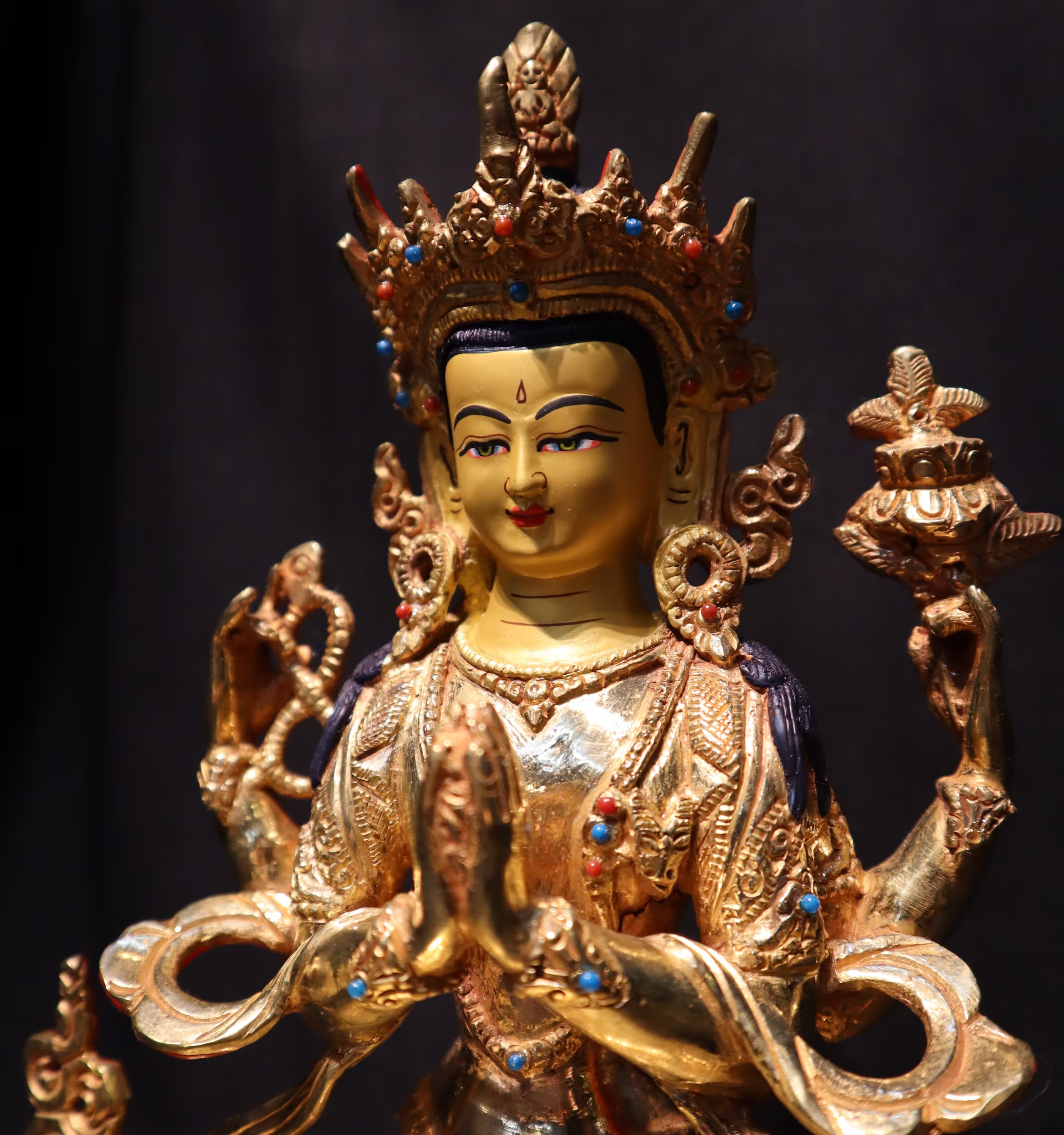
Who is Avalokiteśvara? If you're new to Mahāyāna Buddhism, here's the short version: a bodhisattva is a being who has vowed to achieve full awakening—buddhahoo —so that they may free all sentient beings from suffering. Avalokiteśvara is, in a sense, the bodhisattva of all bodhisattvas — the one who looks upon the world with compassion and cannot rest while beings are suffering. He is known in Tibetan as Chenrezi, in Chinese in female form as Guanyin, and across Asia, he or she is one of the most beloved figures in all of Buddhism.
And The Basket’s Display is the text that, more than any other, introduced Avalokiteśvara to the world.
One of the most striking features of the sūtra is how deeply it is in dialogue with the Hindu world around it. This is a text that knew its audience. Rather than ignoring the gods that many people in India worshipped—Śiva, Viṣṇu, Brahmā—it absorbs them, claiming that all three originated from Avalokiteśvara's body. This is not an uncommon move in the history of religion: when one tradition assimilates the gods of another, it is saying, in effect, yes, those figures are powerful—but they are still subordinate to ours.
Nowhere is this more visible than in the pairing of Śiva and Avalokiteśvara. Śiva is also known as Īśvara—"the lord" or "the ruler"—and that same epithet is embedded in Avalokiteśvara's very name: "The Ever-Watchful Lord." More strikingly still, Avalokiteśvara's mantra, oṁ maṇipadme hūṁ, is clearly patterned on Śiva's own five-syllable mantra, oṁ namaḥ śivāya. Same opening syllable, same devotional structure, six syllables against five. It is a deliberate echo—and a deliberate elevation. This is how traditions absorb and transform one another, creating dense webs of interconnection across what we often imagine as separate religions.
So what actually happens in the sūtra? The sūtra opens in Prince Jeta’s Grove, a monastery near the city of Śrāvastī in northern India. Buddha Śākyamuni is teaching when the assembly is suddenly bathed in miraculous light, and a bodhisattva named Sarvanīvaraṇaviṣkambhin—just try and do your best to pronounce his name—asks the Buddha where the light came from.
The Buddha explains: it came from Avalokiteśvara, who has just returned from visiting the city of the hungry ghosts and the deepest and most terrible of the Buddhist hells. And from there, the text unfolds in a series of nested narratives, each one a flashback that reveals more of the mantra’s history.
We see Avalokiteśvara traveling across the world in a kind of cosmic tour of compassion. He visits the realm of the asuras—the demigods—and teaches them about merit. He visits the yakṣas and the rākṣasas. He goes to Siṃhala Island—associated with Sri Lanka—where, in the form of a handsome man, he persuades a population of dangerous flesh-eating women to renounce violence. He goes to Vārāṇasī and, in the form of a bee, buzzes the prayer of the Three Jewels to insects trapped in a cesspit—liberating them. He goes to a region in Magadhā where beings have been starving and eating each other for twenty years, and causes food to rain from the sky.
These stories are not subtle. They are vivid, sometimes shocking, and they are making one point over and over again: there is nowhere Avalokiteśvara will not go, no being too low or too lost to be beyond his reach.
The second half of the sūtra shifts its focus to the mantra itself. The bodhisattva Sarvanīvaraṇaviṣkambhin seeks the six-syllable mantra, and the Buddha tells him a story about his own past lives—when he, too, had to search for it.
The mantra, it turns out, wasn't easy to find. The future Buddha Shakyamuni eventually received the mantra from Buddha Padmottama. Padmottama, in turn, received it from Avalokiteśvara himself, who shows how the mantra sits to the left of Amitabha in Amitabha’s maṇḍala. Here, the mantra is not simply syllables or sound, but embodied in the form of a goddess—Ṣaḍakṣarī Mahāvidyā, whose name means "The Great Six Syllable Mantra." She is white, with four arms, holding a red lotus in one hand and a rosary in the other.
This is significant. The mantra is not merely a string of sounds. It is a living reality, wisdom, and compassion embodied in female form.
Which brings us to the meaning of the mantra: oṁ maṇipadme hūṁ.
From a Sanskrit perspective, the syllable Oṁ combines three sounds - A, U, and M - which symbolize body, speech, and mind, respectively. Thus, the syllable OM represents the homage or respect, expressed through body, speech, and mind, that a devotee offers to Avalokiteśvara.
Separately, the word Maṇi means "jewel" and symbolizes compassion, while Padme means "lotus" and symbolizes wisdom. Together, Maṇipadmā serves as an epithet of Avalokiteśvara. And so the compound maṇipadmā has a double meaning. On the one hand, it is simply another name for Avalokiteśvara. On the other hand, it evokes the qualities of wisdom and compassion for which Avalokiteśvara is especially known.
The syllable Hūṁ, meanwhile, is said to express a sense of unity. Thus, the mantra can be understood as both an act of homage to Avalokiteśvara and an invocation of the union of compassion and wisdom, which, in Buddhist terms, is the very nature of an awakened mind.
But each of the six syllables also has its own symbolic correspondences. For instance, the six syllables are said to correspond to the six realms of cyclic existence—the gods, the demigods, the humans, the animals, the hungry ghosts, and the hells and reciting the mantra closes the gates to rebirth in each one. Or each syllable corresponds to one of the six root afflictions: pride, envy, lust, stupidity, greed, and anger, which are purified through the recitation of the mantra.
The text is not primarily making an argument. It's creating an atmosphere—a world saturated with Avalokiteśvara's presence, where compassion reaches into every corner of existence, where even insects in a cesspit are not beyond the reach of liberation.
And the mantra at its heart—oṁ maṇipadme hūṁ—is an invitation to participate in that world.
The Tibetan master Dza Patrul Rinpoche captured the spirit of the practice beautifully:
"Avalokiteśvara is the essence of all Buddhas. The six syllables are the essence of all mantras. Awakened Mind is the essence of tantric practice. Recite the six syllables with the knowledge of the one that liberates all."
That is the Kāraṇḍavyūha, The Basket’s Display. So lift the lid. Look into the basket. Recite the six-syllable mantra and dwell in the awakened mind of wisdom and compassion.

Dr. Bob Miller translates and edits texts on the monastic life for monastics, scholars, and the reading public.